Many hazard indices optimize expected crash frequency and return only relative scores. That can under-prioritize locations where crashes are uncommon but the conditional consequence is severe, and it gives agencies no defensible threshold for action.
Completed projectMarch 2025Data science · Decision engineering
Severity-aware hazard ranking for grade crossings
Built a transparent hazard-ranking engine that combines expert safety priorities with severity-specific crash probabilities, converting model output into an actionable statewide screening system.
My roleMethodology Lead · Model Developer · First Author
4.73%crossings classified high-risk
01 / PROBLEM & CONTEXT
Statewide screening requires both analytical consistency and an explanation that safety engineers can audit when deciding which crossings receive scarce field-review resources.
- AHP
- Risk index
- Competing risks
02 / ENGINEERING PIPELINE
How the system moved from raw evidence to a usable decision.
Integrated Analytic Hierarchy Process weights from 16 railway-safety experts with cumulative severity probabilities from a competing-risk model using 29 years of North Dakota data.
Evidence
Data
Twenty-nine years of records for 3,194 public crossings, combined with structured severity priorities elicited from 16 railway-safety experts.
Pipeline
Data engineering
Prepared severity-specific cumulative probabilities, normalized expert comparison weights, and combined the two evidence streams into a repeatable crossing-level scoring workflow.
Signals
Data mining
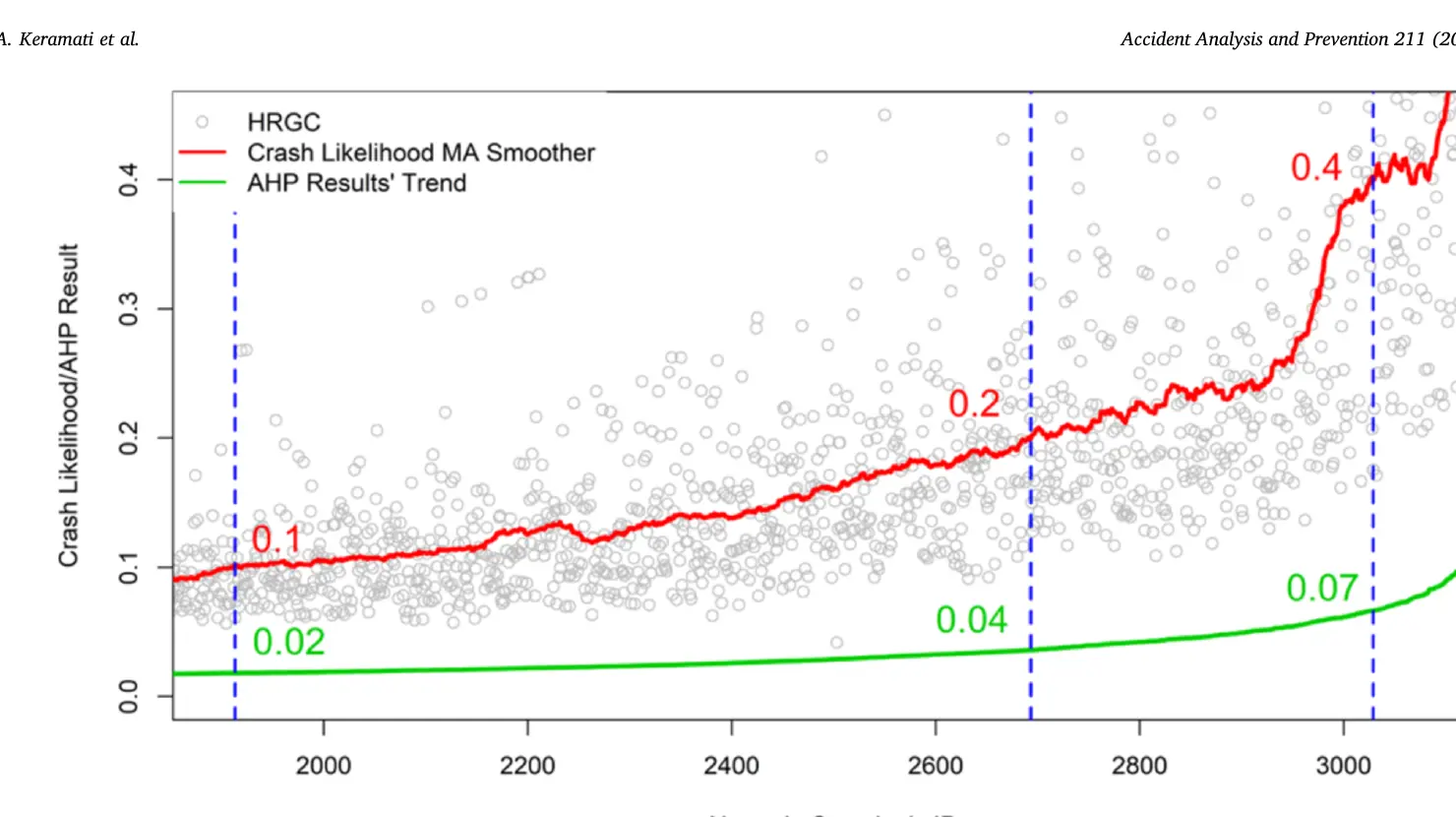
Separated frequent lower-consequence patterns from rarer severe-outcome signals, then examined the score distribution to define operational risk strata.
Model
ML / analytical method
Analytic Hierarchy Process weighting was paired with competing-risk probabilities so expert priorities remained explicit while observed crash behavior determined each crossing's likelihood profile.
Decision
System function
The engine assigns every crossing to one of four intervention levels and exposes the reasoning from severity probability through expert weight to final priority.
Proof
Validation
Weight consistency and the resulting statewide distribution were checked before data-driven thresholds were used to convert continuous scores into operational classes.
Plain-language glossary
Technical terms, made clear.
Analytic Hierarchy Process: a structured method for turning expert pairwise judgments into transparent priority weights.
A combined priority measure that joins modeled crash probabilities with the relative importance of each severity.
03 / KEY INNOVATIONS
What changed in the engineering approach.
Expert judgment is encoded as auditable weights rather than hidden business rules.
Severity-specific probabilities prevent frequent low-consequence events from dominating the ranking.
Data-driven thresholds translate continuous scores into four operational priority levels.
04 / TECHNICAL ARTIFACT
05 / MEASURABLE OUTCOMES
What the system established.
Ranked 3,194 public crossings across four severity-aware intervention levels.
Identified 4.73% of the statewide inventory as high-risk.
Produced a traceable prioritization logic connecting expert criteria to observed outcome probabilities.
06 / AGENCY & INDUSTRY IMPACT
Designed to support a decision.
Provides agencies with a transparent first-stage triage system for targeting engineering review, inspection, and limited improvement funds.
Weight consistency and the resulting statewide distribution were checked before data-driven thresholds were used to convert continuous scores into operational classes.
Gives transportation agencies a first-stage screening engine for targeting engineering review, field inspection, and limited safety-improvement funds.