A warning device cannot be evaluated in isolation. The same upgrade may reduce one outcome but increase another, and its effect depends on the controls and driver expectations already present at the site.
Completed projectAugust 2021Safety analytics · Causal comparison
Context-aware evaluation of crossing countermeasures
Quantified how the safety value of gates, audible warnings, flashing lights, and stop signs changes with the controls already present at a crossing.
My roleProject Lead · Model Developer · First Author
29 yearsnetwork history analyzed
01 / PROBLEM & CONTEXT
Safety engineers need evidence for a specific baseline-and-upgrade combination, not a universal average effect that ignores the devices already installed.
- Cox model
- Marginal effects
- CMF engineering
02 / ENGINEERING PIPELINE
How the system moved from raw evidence to a usable decision.
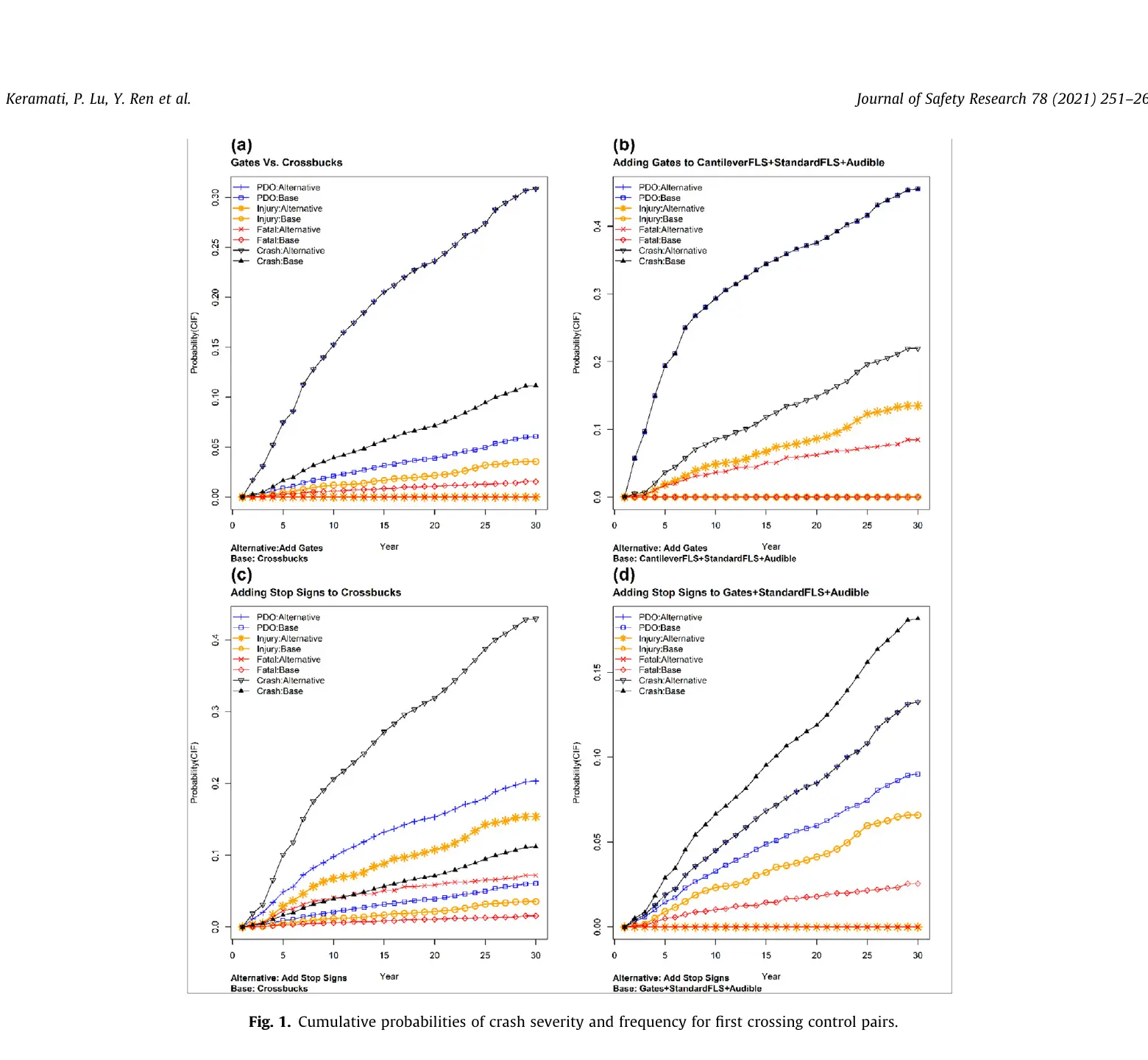
Applied a competing-risk model to a 29-year network dataset and estimated marginal effects for specific before-and-after control pairs, including gates, audible warnings, flashing lights, and stop signs.
Evidence
Data
A 29-year crossing network history with control configurations, crash timing, exposure, and mutually exclusive property-damage, injury, and fatal outcomes.
Pipeline
Data engineering
Encoded longitudinal survival records and explicit baseline-versus-upgrade control pairs so each device comparison retained the real infrastructure context.
Signals
Data mining
Compared how control combinations changed time-dependent risk and exposed outcome tradeoffs that an aggregate crash count would conceal.
Model
ML / analytical method
A competing-risk survival model and marginal effects were used to estimate device changes for specific before-and-after configurations across the service life.
Decision
System function
The analysis returns annual and cumulative changes in crash occurrence and severity for a proposed control upgrade at a defined baseline crossing.
Proof
Validation
Results were checked by outcome and baseline configuration, preventing an apparent benefit for one severity or device context from being generalized to all crossings.
Plain-language glossary
Technical terms, made clear.
The estimated probability change associated with one infrastructure change while the comparison context is held consistent.
A time-to-event method for mutually exclusive first outcomes such as property-damage, injury, or fatal crashes.
03 / KEY INNOVATIONS
What changed in the engineering approach.
Pairwise baseline-versus-upgrade comparisons preserve real infrastructure context.
Competing outcomes reveal tradeoffs hidden by aggregate crash-frequency analysis.
Longitudinal cumulative effects show how device value changes across the service life.
04 / TECHNICAL ARTIFACT
05 / MEASURABLE OUTCOMES
What the system established.
Adding audible warnings to gate-controlled crossings reduced annual crash-occurrence likelihood by 0.25%.
Adding stop signs to crossbuck-only crossings reduced annual crash likelihood by 0.14%.
Some active-control combinations increased selected severe-outcome probabilities, showing why context-specific validation is necessary.
06 / AGENCY & INDUSTRY IMPACT
Designed to support a decision.
Supports context-aware countermeasure selection and gives engineers a quantitative basis for rejecting one-size-fits-all crash-modification assumptions.
Results were checked by outcome and baseline configuration, preventing an apparent benefit for one severity or device context from being generalized to all crossings.
Helps safety engineers select and validate control upgrades for the actual baseline condition instead of relying on a universal average effect.