Road agencies must choose between maintaining, improving, or closing low-volume forest routes while accounting for mill access, truck operating cost, energy use, and emissions across a large multimodal network.
Completed projectFebruary 2020Optimization · Sustainable logistics
Forest-road routing and maintenance optimization
Engineered a statewide network model to test how forest-road maintenance policies reshape mill access, log-truck routing, transportation cost, energy use, and carbon emissions.
My roleOptimization Lead · Model Developer · First Author
16–34%transport-cost reduction
01 / PROBLEM & CONTEXT
Forest-road policy changes route availability far beyond an individual segment, so maintenance decisions must be evaluated as a connected logistics system.
- Network optimization
- ArcGIS
- Scenario engineering
02 / ENGINEERING PIPELINE
How the system moved from raw evidence to a usable decision.
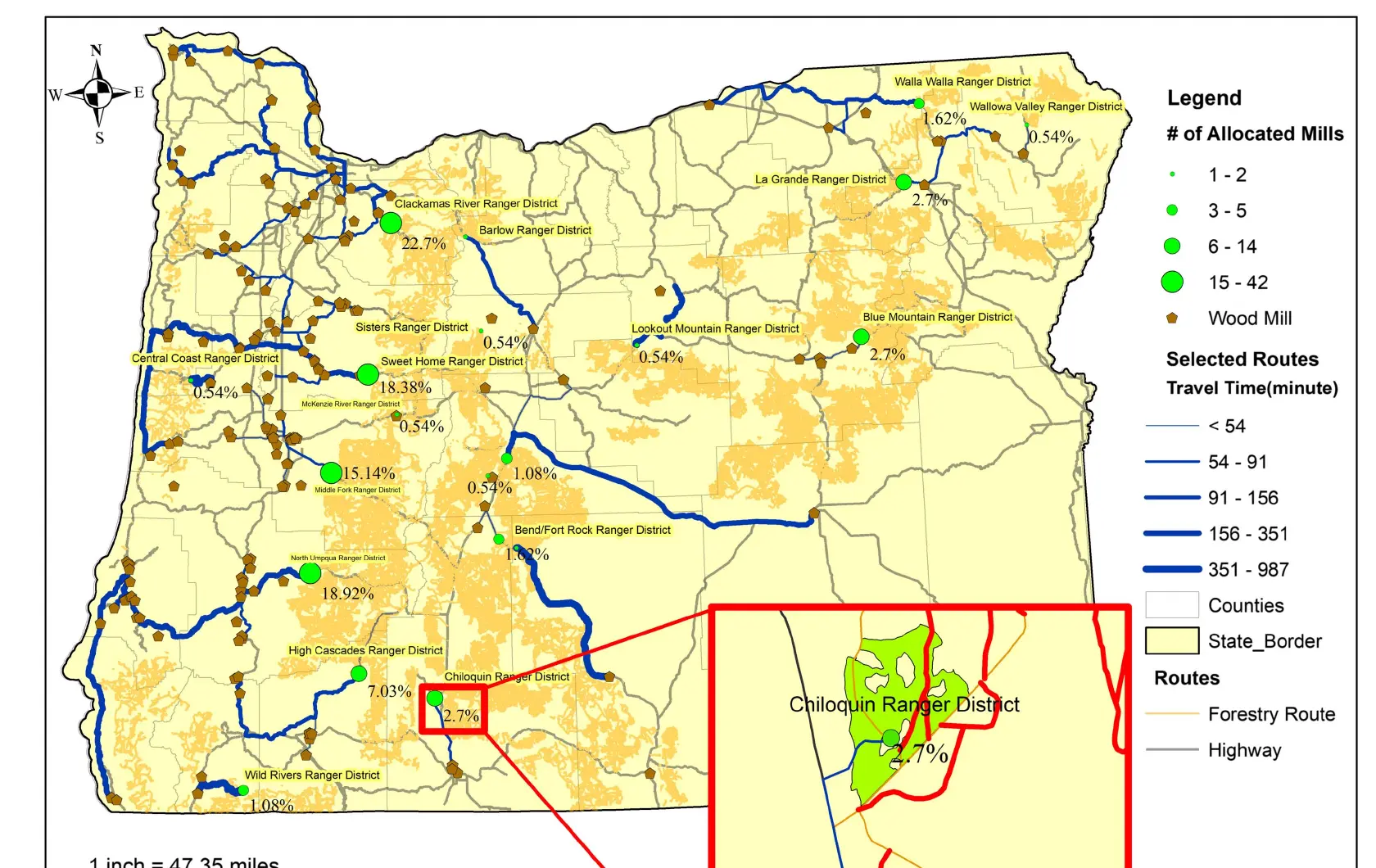
Built an ArcGIS network and allocation model for Oregon forest roads, mills, and timber supply, then evaluated operational maintenance, objective maintenance, and rehabilitation scenarios.
Evidence
Data
Oregon forest-road conditions, timber supply, mill locations, and network travel information used to represent feasible freight movement and facility allocation.
Pipeline
Data engineering
Integrated spatial road, supply, and mill layers in ArcGIS; built routable network inputs; and generated consistent scenario data for alternative maintenance and rehabilitation policies.
Signals
Data mining
Mapped accessibility, bottlenecks, diversion patterns, and regional shifts in timber flow as routes changed under each policy scenario.
Model
ML / analytical method
A network-constrained routing and allocation model connected road condition policy to mill assignment, travel time, transport cost, energy use, and emissions.
Decision
System function
The planning model reroutes timber to feasible mills under each policy and reports the resulting access, cost, travel, fuel, and emissions consequences.
Proof
Validation
Operational, objective-maintenance, and rehabilitation scenarios were compared through the same network and cost logic so policy differences—not inconsistent assumptions—drove the results.
Plain-language glossary
Technical terms, made clear.
Selecting routes and allocations only from paths the real road network makes feasible.
Applying the same model logic to alternative maintenance policies so their consequences can be compared fairly.
03 / KEY INNOVATIONS
What changed in the engineering approach.
Network-constrained allocation links road condition policy to mill-level timber access.
Scenario logic evaluates cost, travel time, fuel use, and emissions within the same routing engine.
Spatial outputs expose regional winners, bottlenecks, and unintended diversion effects.
04 / TECHNICAL ARTIFACT
05 / MEASURABLE OUTCOMES
What the system established.
Reduced modeled transportation cost by approximately 16–34% under alternative policies.
Demonstrated that rehabilitation can increase accessible timber volume by as much as 104%.
Quantified the tradeoff between additional road investment and lower downstream logistics cost and emissions.
06 / AGENCY & INDUSTRY IMPACT
Designed to support a decision.
Helps road agencies, forest managers, and mills evaluate maintenance budgets against freight access, logistics cost, and environmental tradeoffs.
Operational, objective-maintenance, and rehabilitation scenarios were compared through the same network and cost logic so policy differences—not inconsistent assumptions—drove the results.
Provides a practical planning tool for road agencies, forest managers, and mills evaluating maintenance budgets and sustainable freight access.