Grade-crossing crashes are rare, censored, nonlinear, and strongly imbalanced. Property-damage, injury, and fatal outcomes also compete with one another, so treating them as independent classification labels can produce inconsistent probabilities and unsafe rankings.
Completed projectMarch 2026AI/ML engineering · Safety modeling
Time-to-event crash severity with monotonic neural networks
Engineered four monotonic neural architectures that learn when a crash may occur and which severity may emerge, while preserving physically defensible risk behavior across competing outcomes.
My roleProject Lead · Lead Developer · First Author
2–50%discrimination improvement
01 / PROBLEM & CONTEXT
Transportation agencies need severity-specific risk estimates that remain physically credible across long planning horizons—not a single score that hides how risk changes over time.
- AI engineering
- PyTorch
- Monotonic networks
- Competing risks
02 / ENGINEERING PIPELINE
How the system moved from raw evidence to a usable decision.
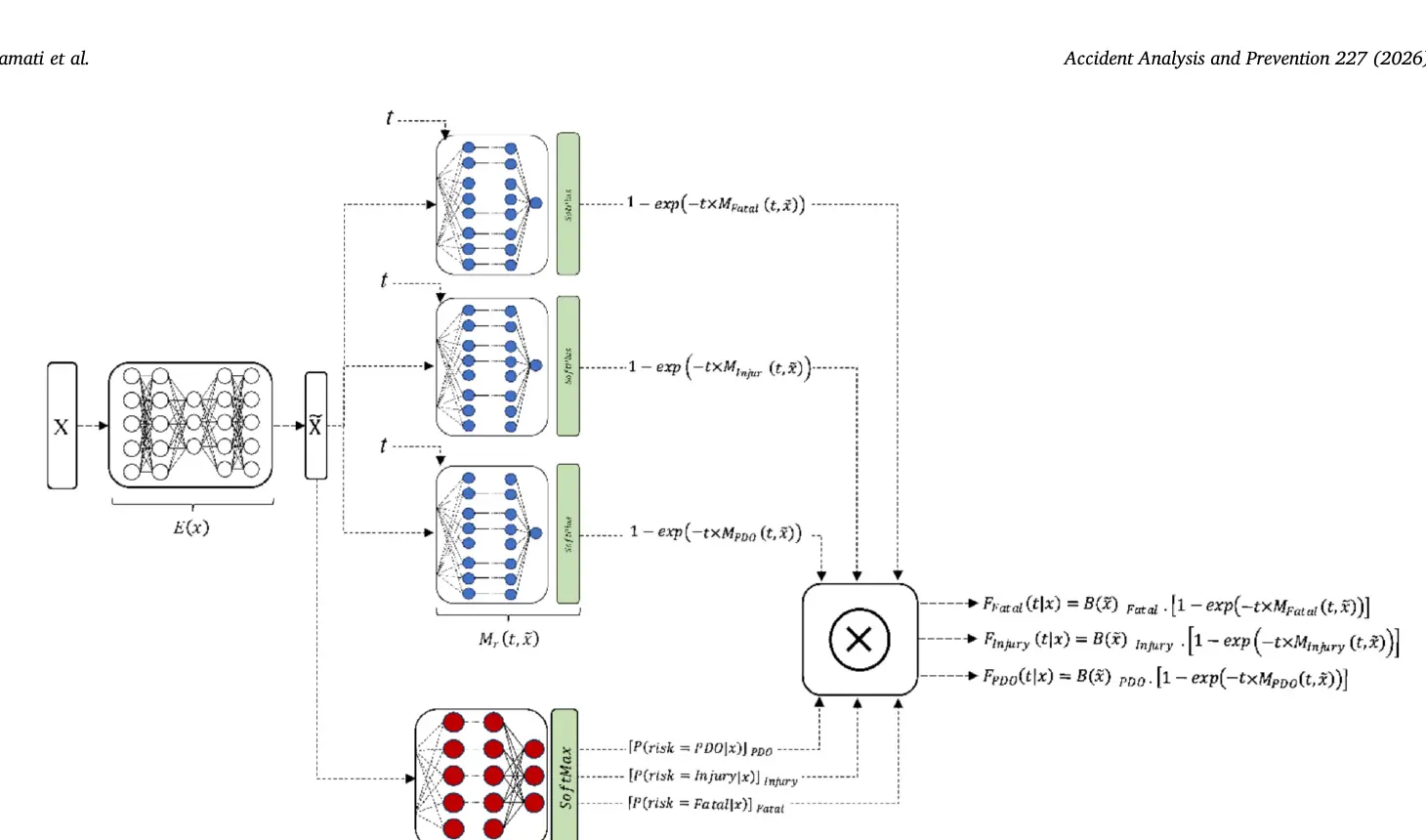
Built and benchmarked four positive monotonic neural-network designs on 29 years of records from 3,310 active public crossings. The engineering pipeline combined constrained layers, severity-specific hazards, calibrated cumulative incidence functions, and time-dependent validation against Cox and Fine–Gray baselines.
Evidence
Data
Twenty-nine years of crossing attributes and crash histories for 3,310 active public North Dakota crossings, including the large censored population with no observed crash.
Pipeline
Data engineering
Aligned longitudinal crossing histories, encoded mixed infrastructure and operating attributes, retained censored records, and prepared severity-specific time-to-event targets for a common model-comparison workflow.
Signals
Data mining
Examined nonlinear, time-dependent relationships and interactions among crossing controls, exposure, and three competing crash outcomes while preserving rare severe events.
Model
ML / analytical method
Four positive monotonic neural architectures were selected to combine neural nonlinearities with a non-decreasing cumulative-risk constraint; cause-specific and multi-head variants were compared with Cox and Fine–Gray baselines.
Decision
System function
The engine returns severity-specific cumulative incidence curves and risk rankings for property-damage, injury, and fatal crashes across future time horizons.
Proof
Validation
A shared evaluation harness compared discrimination, calibration, and computational cost using time-dependent measures and statistical survival baselines.
Plain-language glossary
Technical terms, made clear.
A neural network constrained so cumulative risk cannot move backward as the prediction horizon grows.
How closely predicted probabilities match the event rates that are actually observed.
03 / KEY INNOVATIONS
What changed in the engineering approach.
Monotonic constraints keep cumulative crash risk non-decreasing over time.
Cause-specific and multi-head designs represent dependence among three severity outcomes.
A common evaluation harness compares discrimination, calibration, and computational cost across statistical and neural baselines.
04 / TECHNICAL ARTIFACT
05 / MEASURABLE OUTCOMES
What the system established.
Improved discrimination by roughly 20% on average and by as much as 50% in selected severity-horizon comparisons.
The cause-specific design produced the strongest accuracy-calibration balance; the multi-head design converged fastest.
Revealed context-sensitive effects of flashing lights and stop signs that an aggregate safety score can hide.
06 / AGENCY & INDUSTRY IMPACT
Designed to support a decision.
Gives safety analysts a defensible choice between the strongest accuracy-calibration design and the lower-latency architecture for interactive analytical tools.
A shared evaluation harness compared discrimination, calibration, and computational cost using time-dependent measures and statistical survival baselines.
Supports two engineering needs: high-accuracy countermeasure assessment and lower-latency analytical tools that must return defensible severity-specific risk estimates.