Grade-crossing risk is nonlinear and interaction-heavy, yet rare severe outcomes, censoring, and competing causes make standard random forests and ordinary classifiers unsuitable.
Completed projectJuly 2020AI/ML engineering · Explainable risk
Random survival forest crash-severity engine
Built an open-source random survival forest that learns nonlinear, severity-specific relationships and ranks the contributors that matter most over a 29-year risk horizon.
My roleProject Lead · Model Developer · First Author
<2%fatal-risk prediction error
01 / PROBLEM & CONTEXT
Safety analysts needed a nonlinear model that could preserve time-to-event information and still show which contributors mattered for each severity.
- AI/ML
- Random survival forest
- VIMP
- Open source
02 / ENGINEERING PIPELINE
How the system moved from raw evidence to a usable decision.
Implemented and compared competing-risk survival forests with multiple splitting rules, out-of-bag validation, cumulative prediction error, and event-specific variable importance.
Evidence
Data
A 29-year crossing history with infrastructure, traffic, train-operation, exposure, and severity-specific crash outcomes, including censored no-crash sites.
Pipeline
Data engineering
Prepared competing-risk survival records, event-specific targets, and a reproducible R workflow for forest fitting, prediction-error diagnostics, and contributor analysis.
Signals
Data mining
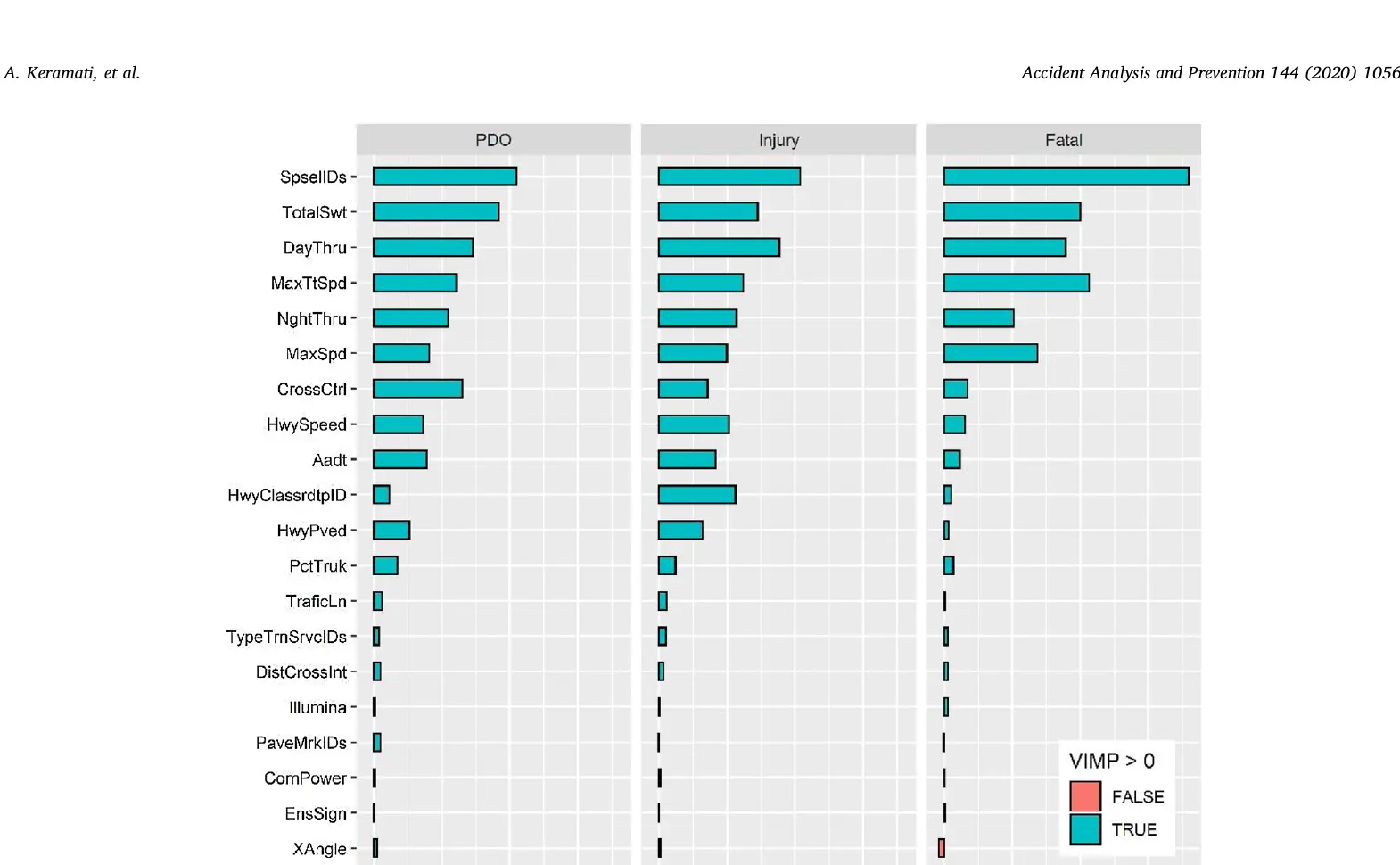
Used event-specific variable importance to discover nonlinear predictive signals and reveal when controls, speed, exposure, and train operations behaved differently by severity.
Model
ML / analytical method
Competing-risk random survival forests were compared across splitting rules, with cumulative prediction error and out-of-bag estimates selected for internal validation.
Decision
System function
The engine estimates severity-specific risk over time and ranks the variables that contribute most to property-damage, injury, and fatal outcomes.
Proof
Validation
Out-of-bag prediction error supplied internal validation, while event-specific errors and VIMP prevented strong performance on common events from masking rare-outcome behavior.
Plain-language glossary
Technical terms, made clear.
An ensemble of decision trees designed for time-to-event data, censoring, nonlinearities, and interactions.
Testing each tree on records it did not use for training, providing built-in performance evidence.
03 / KEY INNOVATIONS
What changed in the engineering approach.
Competing-risk trees model censoring and mutually exclusive severity outcomes directly.
Out-of-bag error supplies internal validation without a separate resampling pipeline.
Event-specific VIMP reveals when a feature matters differently for PDO, injury, and fatal crashes.
04 / TECHNICAL ARTIFACT
05 / MEASURABLE OUTCOMES
What the system established.
Held prediction error below 6.2% for PDO, 4% for injury, and 2% for fatal risk.
Identified crossing controls, speed, traffic exposure, and train operations among the strongest severity-specific contributors.
Released reproducible R implementations for model fitting, diagnostics, and countermeasure analysis.
06 / AGENCY & INDUSTRY IMPACT
Designed to support a decision.
Provides an explainable nonlinear alternative for network screening and releases reproducible code for model fitting and countermeasure analysis.
Out-of-bag prediction error supplied internal validation, while event-specific errors and VIMP prevented strong performance on common events from masking rare-outcome behavior.
Supports nonlinear network screening and interpretable engineering analysis when proportional-hazard assumptions are too restrictive.